

Quick answer
Yes, you can see whales in Hawaii between mid-December and mid-May, when humpback whales migrate from Alaska to breed and calve in Hawaiian waters. Peak viewing runs from January through March, with the highest concentrations around Maui, particularly in the shallow Auau Channel between Maui, Lanai, and Mololokai. Commercial whale watching tours operate daily from harbors across the islands, departing between 7:00 AM and 5:00 PM.
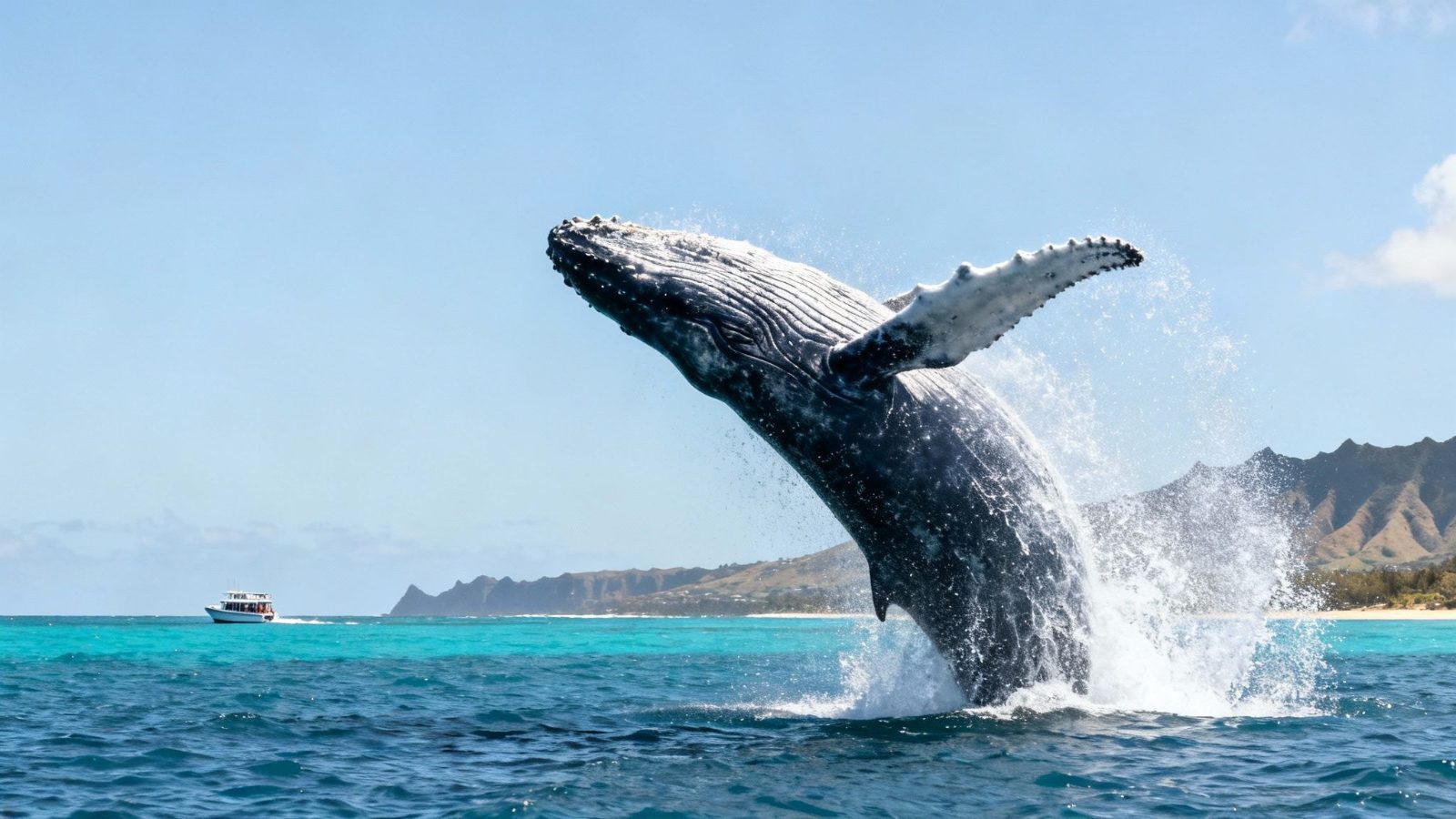
More than 10,000 humpback whales return to the Hawaiian Islands each winter, transforming the archipelago into a natural amphitheater for one of nature's great migrations. The phenomenon draws marine biologists, photographers, and visitors who come to witness breaching, tail slapping, and the haunting songs that carry for miles underwater. Hawaii's protected marine sanctuary status ensures these waters remain undisturbed breeding and calving grounds. Humpback mothers bring newborn calves into shallow coastal areas where warmer temperatures and calmer conditions provide safety from predators. The Auau Channel, a stretch of water less than 200 feet deep between Maui's western shore and the islands of Lanai and Mololokai, hosts the densest whale population. Lahaina Harbor and Maalaea Harbor serve as the primary departure points for commercial whale watching expeditions, though sightings occur across all major islands including Oahu's southern coast and the Big Island's Kona side. Whale watching in Hawaii requires booking a commercial tour, as these are federally regulated waters with strict approach distances. Operators must maintain at least 100 yards from any whale, a rule enforced by the Hawaiian Islands Humpback Whale National Marine Sanctuary. Tours range from large stable catamarans that accommodate 100 passengers to smaller rigid-hull inflatables with 20-passenger limits. Morning departures between 7:00 AM and 10:00 AM offer the calmest sea conditions before trade winds pick up, increasing the likelihood of clear sightings and stable filming conditions. The whales remain until late April or early May, when they begin the northern migration back to Alaskan feeding grounds. By mid-May, sightings drop to near zero. Visitors planning trips outside the December-to-May window will not encounter humpbacks, though other cetacean species including spinner dolphins and pilot whales inhabit Hawaiian waters year-round. Commercial tour operators follow the whale migration closely and cease dedicated whale watching tours once the season ends.
“More than 10,000 humpback whales return to the Hawaiian Islands each winter, transforming the archipelago into a natural amphitheater for one of nature's great migrations.”
When Can You See Whales in Hawaii: Seasonal and Daily Best Practices
The peak season to observe humpback whales in the Hawaiian Islands occurs from January through March. Morning hours between 07:00–10:00 provide the most favorable conditions for spotting activity due to lower wind speeds and calmer sea states.
Peak Season (Jan–Mar)
High activity; popular period70°F–80°F; generally calm waters
This window offers the highest probability of whale sightings as the population peaks. Morning tours are recommended to avoid midday trade winds.
Shoulder Season (Dec & Apr)
Moderate activity; thinning crowds72°F–82°F; variable conditions
Whales begin arriving in December and depart by late April. Visibility remains high for those avoiding the mid-winter peak.
Daily Morning Window
Lowest crowd density—
The best arrival window is 07:00–10:00. Calm ocean conditions provide superior surface visibility for spotting breaching and tail slapping.
Verdict: The optimal time for whale watching is between January and March during the 07:00–10:00 morning window.
Is It Free to See Whales in Hawaii?
Admission costs depend entirely on how you choose to observe the whales. Viewing from the shoreline is free, while commercial boat tours require individual reservations.
While observing from the shore is 0 USD, a typical adult pays a variable commercial rate for boat tours depending on the selected operator and vessel.
How to Book and Can You See Whales in Hawaii Effectively
Seeing whales in Hawaii requires aligning your visit with migration patterns and choosing between shore-based observation or a commercial boat tour. The full process—from research to being on the water—typically spans a few days to a week of planning.
Check that your travel dates fall between December and April, when humpback whales migrate to Hawaiian waters. Outside this window, sightings drop to near zero.
Decide between shore and boat observation
Shore viewing from coastal lookouts is free but distant; boat tours offer closer encounters and require advance booking through licensed operators. Morning departures between 07:00–10:00 provide calmer seas and higher activity.
Reserve a commercial whale-watching tour
Book directly through tour operators or aggregator platforms at least 48–72 hours ahead during peak season (January–March) to secure availability. Confirm the vessel is certified for whale watching and departure times align with the 07:00–10:00 optimal window.
Prepare for ocean conditions
Bring sun protection, layered clothing for wind and spray, and motion-sickness remedies if prone to seasickness. Tours operate rain or shine; cancellations occur only in unsafe sea states.
Arrive at the harbor early
Opening Hours: When Can You See Whales in Hawaii on Official Tours
The following schedule reflects the standard operational hours for coordinating whale watching logistics across the Hawaiian Islands. These hours apply to the administrative and booking access for official tours.
| Monday | 07:00–17:00 | |
|---|---|---|
| Tuesday | 07:00–17:00 | |
| Wednesday | 07:00–17:00 | |
| Thursday | 07:00–17:00 | |
| Friday | 07:00–17:00 | |
| Saturday | 07:00–17:00 | |
| Sunday | 07:00–17:00 |
Rules for When You See Whales in Hawaii
Federal law protects humpback whales in Hawaiian waters under the Marine Mammal Protection Act and Endangered Species Act. Boats must maintain a 100-yard distance, and swimmers and drones must stay at least 100 yards away to avoid disturbing these migrating animals.
Do
- Keep 100 yards from whales by vessel at all times
- Turn off engines if whales approach within 100 yards
- Report injured or entangled whales to NOAA hotline immediately
- Follow all captain instructions regarding marine wildlife viewing
- Use binoculars to observe whales from proper legal distance
Don't
- Don't attempt to swim with or approach whales
- Don't chase whales or position vessel in their path
- Don't fly drones within 1,000 feet of marine mammals
- Don't feed or throw objects toward whales
- Don't make sudden loud noises near whale pods
Check availability
Frequently Asked Questions: Can You See Whales in Hawaii
Everything you need to know about can you see whales in hawaii